
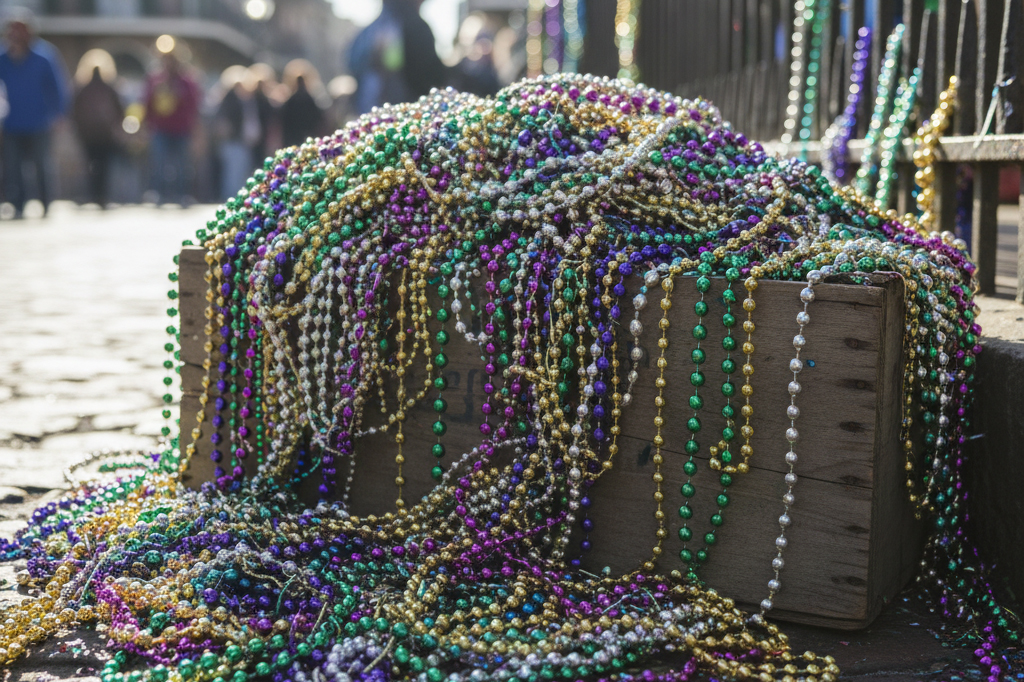
It is easy to think of Mardi Gras beads as just shiny souvenirs, tossed from parade floats, draped over balconies, and eventually tangled around telephone wires long after the last float rolls through. But to understand New Orleans, you have to understand the bead. Each one, from the smallest trinket to the most elaborate handmade throw, carries a piece of the city’s story.
Mardi Gras beads were not always plastic, and they were not always disposable. In the early days of Carnival parades, glass beads were imported from Europe and thrown to the crowd as a symbol of generosity and celebration. They were fragile, beautiful, and collectible. People prized them like keepsakes, not clutter. When plastic replaced glass in the 1960s and mass production took over, the tradition evolved but never lost its spirit. What changed was not the idea of giving, but the meaning behind the gesture.
Today, every bead tells you something about the krewe that throws it and the person who catches it. A golden string might come from a float celebrating a century-old society, while a hand-decorated medallion could be the work of a local artist who spent weeks preparing for parade season. Throws have become as expressive as the costumes themselves. Many krewes now focus on eco-friendly or reusable beads, while others commission custom items that reflect their themes, including painted coconuts or doubloons stamped with messages of resilience after hurricanes.
The bead toss is more than a spectacle. It is a shared ritual. For one fleeting moment, strangers lock eyes in a crowd, both smiling, both part of the same celebration. That exchange, quick, colorful, and full of joy, is a small act of community that defines New Orleans as much as any song or dish. It is art in motion, generosity in tangible form, and proof that even the smallest object can hold centuries of culture.
Because in New Orleans, a bead is never just a bead. It is a promise that joy will always find its way back to the streets.



 The Pelican Star
Leave a comment